Types of Network Topologies: Explained with Examples
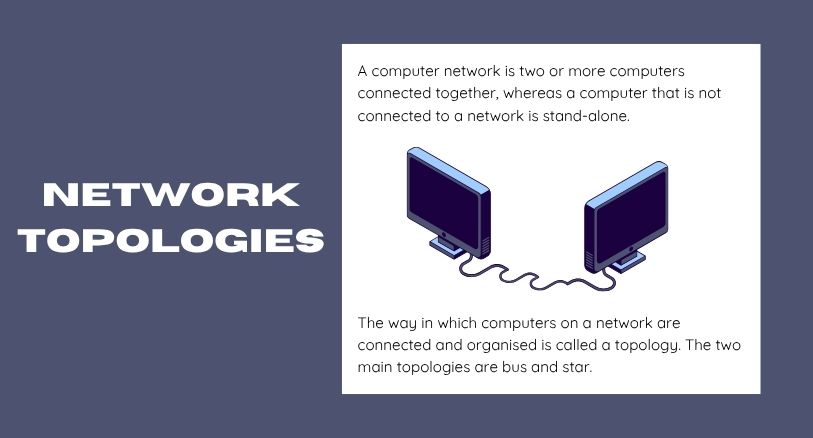
The types of network topologies describe the different ways devices and network connections can be arranged. Every computer network needs some form of structure. This structure determines how computers, servers, switches, routers, and other devices connect and communicate with each other.
Different network designs serve different purposes. A small office may use a simple structure with all devices connected to one switch. A large organization may use multiple layers and redundant connections to improve scalability and reliability. Because of this, understanding the different topology types is important when learning how computer networks are designed.
For a broader explanation of the concept, see Network Topology Explained.
What Are the Main Types of Network Topologies?
The main types of network topologies are:
- Star topology
- Bus topology
- Ring topology
- Mesh topology
- Tree topology
- Hybrid topology
Each topology has a different structure. Some are simple and easy to manage, while others provide better redundancy or scalability.
Star Topology
Star topology is one of the most common network structures. In this arrangement, every device connects to a central device, usually a network switch.
For example, imagine ten computers in an office. Instead of connecting every computer directly to another computer, each one connects to the same central switch. Communication between devices passes through that central connection point.
One advantage of star topology is that an individual device or cable failure usually does not affect the other devices. It is also relatively easy to add new devices to the network.
However, the central switch is an important part of the network. If it fails, the devices connected through it may lose communication.
Bus Topology
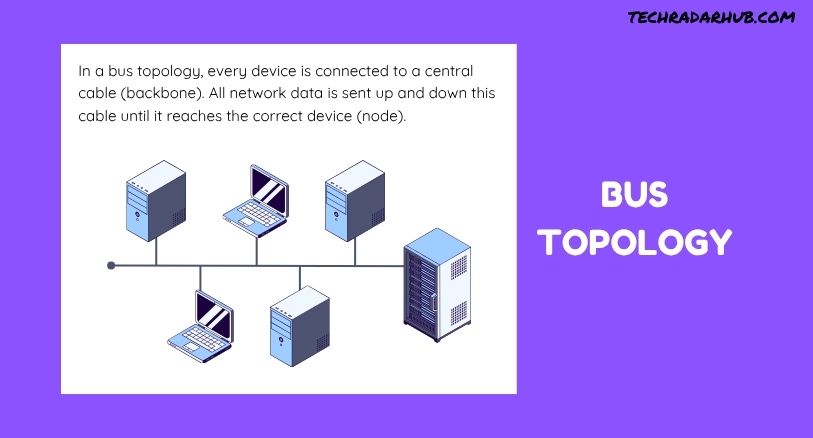
Bus topology connects multiple devices through a single shared communication line called a backbone. All connected devices use this common path for communication.
This design was more common in earlier computer networks because it required less cabling and had a relatively simple structure. However, as the number of connected devices increases, managing communication can become more difficult.
A major limitation is the shared backbone. If the main connection develops a problem, communication across the network can be affected. Because of these limitations, bus topology is rarely used in modern Ethernet networks.
Ring Topology
In ring topology, devices connect in a circular arrangement. Each device connects to neighboring devices, creating a continuous path around the network.
Data can travel around the ring according to the communication method used by the network. Some ring systems send data in one direction, while others can support communication through multiple directions.
Ring topology provides an organized structure, but a failure in the communication path can affect network operations depending on the design. Adding or removing devices may also require changes to the network.
Although traditional ring networks are less common today, the concept remains important for understanding different network structures.
Mesh Topology
Mesh topology uses multiple connections between devices. In a full mesh topology, every device connects directly to every other device. A partial mesh uses multiple connections only between selected devices.
The biggest advantage of mesh topology is reliability. If one connection fails, another communication path may still be available. This can improve fault tolerance and reduce dependence on a single connection.
However, mesh networks can become expensive and complex. As more devices are added, the number of required connections can increase significantly. For this reason, full mesh designs are usually used only when high availability is extremely important.
Tree Topology
Tree topology uses a hierarchical structure. Groups of devices connect to local network devices, and those devices connect to higher-level network infrastructure.
For example, computers on one floor of an office building may connect to a local switch. The switches from different floors can then connect to a larger central switch or core network device.
This structure makes tree topology useful for larger networks. It can support expansion because new sections can be added to the hierarchy. It also helps organize large numbers of devices into manageable groups.
However, higher-level network devices become important connection points. A failure at one level can affect the sections connected below it.
Hybrid Topology
Hybrid topology combines two or more topology types within the same network. This is common in large organizations because one topology may not meet every requirement.
For example, a company may use star topology within individual departments while connecting those departments through a tree-like structure. The overall network therefore combines multiple designs.
Hybrid topology offers flexibility and can support complex network requirements. However, planning and managing the network can become more difficult as the infrastructure grows.
Comparing the Different Types of Network Topologies
| Topology | Structure | Main Advantage | Main Limitation |
|---|---|---|---|
| Star | Devices connect to a central device | Easy to manage | Central device dependency |
| Bus | Devices share one backbone | Simple design | Backbone failure can affect the network |
| Ring | Devices form a circular path | Organized communication | Path failures can cause disruption |
| Mesh | Multiple connections between devices | High reliability | Complex and expensive |
| Tree | Hierarchical structure | Good scalability | Higher-level dependency |
| Hybrid | Combination of structures | Flexible | Complex to manage |
Which Network Topology Is Best?
There is no single best topology for every network. The right choice depends on the size of the network, the number of devices, budget, reliability requirements, and expected future growth.
For many modern local networks, a star-based structure is a practical choice because it is relatively easy to manage and expand. Larger organizations may use tree or hybrid structures to organize different departments and locations.
Networks that require high availability may also use redundant connections similar to mesh designs. The final choice depends on the specific requirements of the organization.
The available Components of a Computer Network also influence which topology can be implemented. Switches, routers, access points, cables, and other infrastructure play different roles depending on the network design.
Physical and Logical Topologies
The types of network topologies can also be classified as physical or logical.
A physical topology describes the actual arrangement of devices and network connections. It focuses on the hardware and physical links between devices.
A logical topology describes how data travels through the network. The logical communication path may differ from the physical layout.
For example, devices may physically connect to a central switch, but the rules that control data transmission determine the logical behavior of the network.
Understanding both concepts helps create a clearer picture of how networks are structured and how communication takes place.
Why Understanding Network Topologies Matters
Learning the different types of network topologies helps you understand how networks are designed for different situations. The arrangement of devices can affect performance, reliability, scalability, cost, and troubleshooting.
A simple topology may be enough for a small network. However, a growing organization may need a more structured design that supports additional devices and locations.
Understanding topology also connects directly with the broader study of computer networking. Once you understand What Is Computer Networking?, it becomes easier to see why network structure plays such an important role in communication.
Frequently Asked Questions
What are the main types of network topologies?
The main types are star, bus, ring, mesh, tree, and hybrid topology.
Which network topology is most commonly used?
Star topology is widely used in modern local networks because devices can connect through a central switch, making the network easier to manage and expand.
What is the difference between mesh and star topology?
In a star topology, devices connect to a central device. In a mesh topology, devices have multiple direct connections with other devices, which can provide additional communication paths.
What is hybrid topology?
Hybrid topology combines two or more different topology structures within the same network.
Which topology is suitable for large networks?
Tree and hybrid topologies are often suitable for larger networks because they can organize devices into structured sections and support expansion.


Post Comment