






What is ICT (information and communications technology)?
Introduction
When you come across the term ICT, it’s natural to wonder what it actually means and why it is used so widely. ICT stands for Information and Communication Technology, a broad term that refers to the technologies used to handle information and support communication in digital form. This includes computers, the internet, mobile devices, software, and communication networks that help people create, store, process, and share information.
ICT plays an important role in everyday life, from education and business to healthcare and government services. Whether it’s sending emails, accessing online learning platforms, using cloud services, or communicating through mobile networks, ICT forms the backbone of modern digital systems. Understanding what ICT means helps you better grasp how technology supports communication and information flow across different industries.
In this article, we’ll explain ICT in simple terms, explore its key components, and understand why it is so important in today’s connected world. This explanation is part of our Definitions section, where we break down technical terms in simple language.
What Is ICT and Why Is It Everywhere?
So, what is ICT?
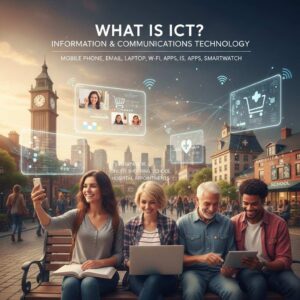
The acronym ICT means Information and Communications Technology. Basically, it is anything that can facilitate the access, storage, and sharing of information or communication with others. So, don’t hesitate to think that your mobile phone, email, a laptop, Wi-Fi, apps, and even a smartwatch are ICT-related.
After you learn what is ICT, you cannot help but see it everywhere. From online shopping, school classes to hospital appointments, ICT is there to provide comfort to us by working in the background. And since the technological world is not going to stop developing, knowing ICT is almost as important as knowing how to send a text message.
What Is ICT in Simple Words?
We explain it to a friend who knows nothing about the topic.
‘It is a set of digital devices such as computers, telephones, and networks that support our communication and sharing of information.’
That’s all there is to it.No complex explanations.Just a simple and friendly way to get to grips with it.
Just think of It as one giant digital ecosystem. No matter what app, device, or website you use, it is just a tiny element of that system.
Key Components
Looking at the main parts of the its and the way these;
Worded different but with the same meaning: “Understanding what is ICT becomes easier when we look at its main parts.” “These…
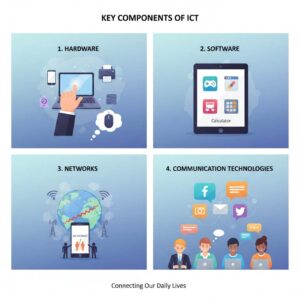
1. Hardware
These are the tangible machines that we can touch – laptops, cell phones, printers, routers, servers, and tablets.
The story I remember is when I was helping my cousin to get her new laptop ready, and she was totally amazed when I told her that even a basic computer mouse is considered as part of hardware.
2. Software
Software is all the things that come with the device – apps, games, browsers, operating systems, editing tools, and what not.
Even if it’s just the calculator app on your smartphone, it’s still a part of IT.
3. Networks
If it were for Networks like Wi-Fi and mobile data, connecting would be impossible.
We all feel the weight of the lack of the networks – like when your internet goes off, and you’re reminded of how vital networks are in the ICT world at that moment.
4. Communication Technologies
These consist of messaging apps, email, video calls, online meetings, and social media.
Actually, these resources have become a necessity in the everyday life of most people.
All these elements combine to pinpoint precisely ICT and how it is our daily exposure without even noticing.
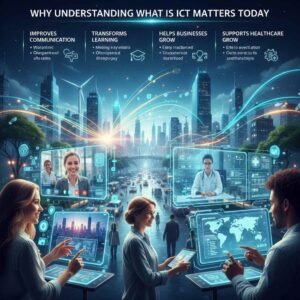
Why Understanding What Is ICT Matters Today
Knowing the meaning of ICT is more crucial than ever before. Since we use digital devices for almost everything, having skills in ICT is a must.
It Improves Communication
With ICT, communication is done instantly and easily. You can send messages to friends who live in another country, upload photos in a blink of an eye, or participate in a virtual meeting without leaving your house.
It Transforms Learning
Nowadays, schools are equipped with digital boards, online notes, and educational applications. Even during my college days, I remember that ICT came to my rescue several times when I forgot my notes and had to quickly download the lecture slides.
It Helps Businesses Grow
Through the help of ICT tools, businesses are able to store data, do live chats with customers, manage online sales, and run advertisements. This is the primary reason why small businesses can expand at a quicker pace nowadays.
It Supports Healthcare
Healthcare professionals employ of its for telemedicine, digital records, patient tracking, and online consultations. This has resulted in healthcare becoming easier for everyone, particularly those who are living in faraway areas.
Real Examples to Understand What Is ICT Clearly
Sometimes examples speak better than the definitions. Here are some everyday instances that illustrate ICT in real life:
- Ordering food online
- Sending a Gmail message
- Watching YouTube tutorials
- Attending an online interview
- Using Google Maps
- Paying bills through UPI apps
- Playing online games
- Saving files on Google Drive
Each of these represents a tiny fraction of a huge ICT framework
What Is ICT in Education? Let’s Break It Down
Teachers, when explaining ICT, mostly concentrate on its influence on learning. And in fact, ICT has changed the whole educational system more than we think.
Presently, schools and colleges make use of:
- Smart classrooms
- Tablets for assignments
- Online tests
- Educational videos
- Virtual labs
- AI-based learning apps
Students get more involved. Teachers can easily monitor progress. Even parents are kept in the loop. ICT has just made education more convenient and enjoyable.
Future Trends
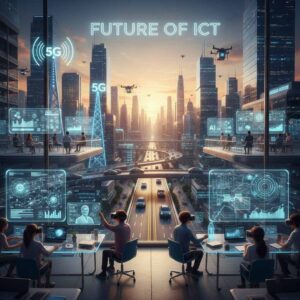
ICT will be very different in the future, and it’s a nice thought. Once you figure out what information and communication technology is, you’ll see that it’s not simply a matter of a few trendy gadgets — it’s mostly about breakthrough innovation. These are the main trends that will come soon:
- AI tools that automate work
- 5G networks for faster communication
- Self-driving cars
- Smart cities powered by IoT
- Virtual reality classrooms
- Cloud-based working environments
In addition, the future will be even more dependent on ITC ; thus, it will be necessary to keep up with the latest developments.
Conclusion
Now you are pretty clear about information and communication technology is. It is the technology that connects people, devices, information, and ideas.
It determines how we learn, work, shop, and communicate. And as it grows, it will inevitably become the lifeblood of our everyday existence in the future.
Next time you open your phone, browse a website, or send a message, think about it — ICT is the one that is helping you but you can’t see it.
Share this content:


Post Comment