Network Architecture Explained: Types, Components and Models
A computer network is not just a collection of connected devices. Those devices need a proper structure that defines how they communicate, share resources, and deliver services. This structure is known as network architecture. It describes how a network is designed and organized. It also explains how devices, software, communication protocols, and services work together. Think of it like a building plan. Before constructing a large building, architects decide where everything should go. Similarly, before building or managing a network, there needs to be a structure for how different parts will interact.
In this article, we will explain the concept in simple terms, including its components, types, models, and importance.
What Is Network Architecture?
Network architecture is the overall design and structure of a computer network.
It defines how different parts of the network communicate and work together.
These parts may include:
- Computers and other end devices
- Servers
- Switches
- Routers
- Network interfaces
- Communication protocols
- Network services
- Security systems
- Software
A well-designed architecture helps ensure that the network can operate efficiently and support its intended purpose.
For a broader introduction to the subject, start with What Is Computer Networking?
How Does Network Architecture Work?
Network architecture creates a framework for communication.
For example, imagine an employee opening an application hosted on a company server.
The employee’s computer sends a request through the network.
The request passes through network devices such as switches and routers.
Communication protocols define how the information is transmitted.
The server receives and processes the request.
Finally, the server sends a response back to the employee’s device.
The architecture determines how these different systems are organized and how they interact.
This process becomes easier to understand when you know the role of the Components of a Computer Network.
Main Components of Network Architecture
A network architecture combines multiple components.
End Devices
End devices are the systems that send and receive data.
Examples include:
- Computers
- Laptops
- Smartphones
- Printers
- IoT devices
These devices often act as clients, servers, or both.
Network Devices
Network devices manage and forward communication.
Common examples include:
- Switches
- Routers
- Gateways
- Wireless access points
- Firewalls
Each device performs a different function within the architecture.
Servers
Servers provide resources and services to other devices.
For example, an organization may use separate servers for:
- Websites
- Applications
- Databases
- Files
- Authentication
The way these servers are placed and accessed forms part of the network design.
Communication Protocols
Protocols provide the rules that devices use to communicate.
Examples include:
- TCP
- UDP
- HTTP
- HTTPS
- DNS
- DHCP
Without common communication rules, different systems would struggle to exchange information correctly.
Network Services
Networks can provide services such as:
- File sharing
- Internet access
- Web applications
- Remote access
- Authentication
The architecture defines how these services are delivered to users and devices.
Client-Server Architecture
Client-server architecture is one of the most common network models.
In this model, clients request services from centralized servers.
A client can be:
- A computer
- A smartphone
- A web browser
- An application
The server receives requests and provides the required service.
For example, when you visit a website:
- Your browser acts as the client.
- The browser sends a request.
- The web server receives the request.
- The server processes it.
- The server sends a response.
- Your browser displays the webpage.
This model is widely used because centralized servers can simplify management and security.
Advantages of Client-Server Architecture
- Centralized management
- Easier resource control
- Better scalability
- Centralized security policies
- Simplified backups
Limitations
- Server failure can affect services
- Infrastructure costs can increase
- Administration may require specialized skills
Despite these limitations, client-server architecture is widely used in businesses and online services.
Peer-to-Peer Architecture
Peer-to-peer, or P2P, architecture allows connected devices to communicate more directly.
In this model, devices can act as both clients and resource providers.
For example, two computers can share files directly without relying on a dedicated central server for every transfer.
Advantages of Peer-to-Peer Architecture
- Simple for small environments
- Lower infrastructure requirements
- Direct resource sharing
- Reduced dependence on a central server
Limitations
- More difficult to manage at scale
- Security can be harder to control
- Resource availability depends on participating devices
Peer-to-peer architecture can work well for smaller or specialized environments.
Client-Server vs Peer-to-Peer
| Feature | Client-Server | Peer-to-Peer |
|---|---|---|
| Management | Centralized | Distributed |
| Dedicated Server | Usually required | Not always required |
| Scalability | Generally higher | Can be limited |
| Security Control | More centralized | More distributed |
| Best For | Businesses and large services | Small or direct-sharing environments |
The right model depends on the purpose and requirements of the network.
Centralized and Distributed Architecture
Network architecture can also be viewed based on where services and resources are located.
Centralized Architecture
In a centralized architecture, important resources and services are managed from central systems.
For example, an organization may host its applications and databases in one central data center.
Users from different locations connect to those services.
This approach can simplify management.
However, it can also create dependency on central infrastructure.
Distributed Architecture
A distributed architecture spreads resources or services across multiple systems or locations.
For example, an organization may operate servers in several regions.
Users can access services from different locations.
This approach can improve scalability and resilience.
However, it can also increase design and management complexity.
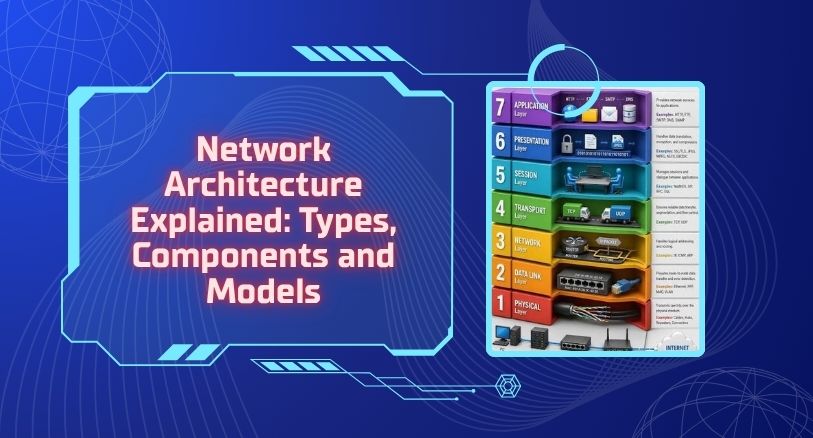
Layered Network Architecture
Networking often uses a layered approach.
Instead of treating communication as one large process, networking divides it into different functional layers.
Each layer performs specific tasks.
This makes complex communication easier to design and understand.
The two most commonly discussed networking models are:
- OSI model
- TCP/IP model
The OSI model is commonly used as a conceptual framework for understanding networking functions.
The TCP/IP model is closely associated with how modern internet communication works.
These models will be covered separately in the Computer Networking cluster because they require more detailed explanations.
Network Architecture and Network Topology
Network architecture and network topology are related, but they are not the same. Architecture describes the overall design of the network. Topology focuses on how devices and connections are arranged.
For example, a company may use a client-server architecture while arranging its local devices in a star topology.
Therefore, architecture describes the broader structure, while topology focuses more on the physical or logical arrangement of connections.
Common Network Architecture Designs
Organizations can design networks in different ways depending on their needs.
Some common approaches include:
Small Office Architecture
A small office network may include:
- Internet connection
- Router
- Switch
- Wireless access point
- Employee devices
The architecture is relatively simple.
Enterprise Architecture
A large organization may require:
- Multiple routers
- Managed switches
- Dedicated servers
- Firewalls
- Wireless infrastructure
- Remote access systems
- Multiple locations
The design becomes more complex because it must support more users and services.
Cloud-Based Architecture
Modern organizations can also use cloud services as part of their architecture.
Instead of hosting every application on local servers, organizations can access infrastructure and services through remote data centers.
This creates hybrid environments where local networks connect with cloud-based resources.
The type of architecture depends on the organization’s requirements and the Types of Computer Networks it uses.
Factors That Influence Network Architecture
Several factors affect network design.
Network Size
A home network requires a simpler design than a multinational organization.
Number of Users
More users may require additional capacity and infrastructure.
Performance Requirements
Applications such as video conferencing and real-time systems may require low latency and reliable connections.
Security
Sensitive environments may need stronger access controls, segmentation, and monitoring.
Scalability
A network should be able to grow without requiring a complete redesign.
Reliability
Important services may need backup systems and alternative communication paths.
Cost
Organizations must balance performance and reliability against infrastructure and operational costs.
Why Is Network Architecture Important?
A poor network design can create problems as the network grows.
For example, an organization may experience:
- Slow performance
- Difficult management
- Security gaps
- Limited scalability
- Service interruptions
A well-planned architecture helps avoid many of these problems.
It creates a clear structure for communication and resource sharing.
It also makes future upgrades easier.
For example, an organization can design its network with additional capacity so that more users or devices can be added later.
Network Architecture in a Real-World Example
Imagine a company with three offices.
Each office has:
- Employee computers
- Local switches
- Wireless access points
- A router
The local devices connect through the office network.
The routers connect each office to a larger company network.
Employees access centralized applications hosted on company servers.
Remote employees connect through secure remote access services.
This environment may combine several architectural concepts.
It can use client-server communication, distributed infrastructure, local networks, and wide-area connections.
The overall design determines how all these elements work together.
Network Architecture vs Network Infrastructure
These terms are closely related but slightly different.
Network architecture refers to the overall design and structure.
Network infrastructure refers to the actual hardware, software, and services that make the network operate.
For example:
The architecture may specify that an organization uses a centralized client-server model.
The infrastructure includes the actual servers, routers, switches, cables, and software used to implement that design.
In simple terms:
Architecture = the design
Infrastructure = the systems used to implement the design
How to Choose the Right Network Architecture
There is no single architecture that works for every organization.
The right choice depends on several questions:
- How many users will connect?
- What applications will they use?
- Where are the users located?
- How much performance is required?
- What level of security is needed?
- Does the network need to grow?
- What is the available budget?
A small business may need a simple centralized design.
A large organization may need distributed systems across multiple locations.
Therefore, the architecture should match the actual requirements rather than follow a one-size-fits-all approach.
Frequently Asked Questions
What is network architecture in simple words?
Network architecture is the overall design that defines how devices, services, protocols, and infrastructure work together in a computer network.
What are the two main types of network architecture?
Client-server and peer-to-peer are two commonly discussed network architecture models.
Is network architecture the same as network topology?
No. Network architecture describes the overall network design, while topology describes how devices and connections are arranged.
Why is network architecture important?
It helps organizations create networks that are manageable, secure, scalable, reliable, and suitable for their requirements.
What is the difference between network architecture and infrastructure?
Architecture is the design or blueprint. Infrastructure consists of the actual hardware, software, and services used to build that design.
Final Thoughts
Network architecture provides the blueprint for how a computer network operates.
It brings together devices, servers, communication protocols, network services, and infrastructure into one organized system.
Client-server and peer-to-peer architectures provide different approaches to communication and resource sharing. Centralized and distributed designs offer different ways to organize services and resources.
As networks become larger, good architecture becomes even more important.
Once you understand the basic structure of network architecture, the next major concept is how devices are physically and logically arranged through network topology.



Post Comment