







203.160.175.158:14001: Understanding This IP and Port Combination
Have you ever found the string 203.160.175.158:14001 somewhere and asked yourself what in the world it is? It might even be that those numbers represent some kind of secret code for an underground society. To be fair though, the truth is rather far from that. It is actually the way a network works. Before long, you realize that it isn’t that confusing after all.
It took me a moment to take in 203.160.175.158:14001 when I saw it for the first time. I questions. “Is this safe? Is it fake? What is it all about?” Later I had this epiphany: “If only I knew how the internet language works, everything would be more than clear.” That’s exactly what we’re going to do together.
What Is 203.160.175.158:14001? Breaking the Unique Identifier Down
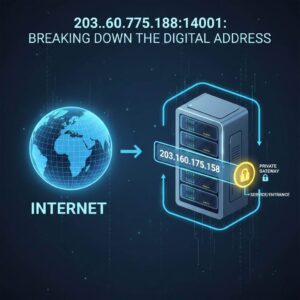
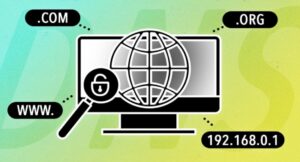
In brief, 203.160.175.158:14001 denotes a combination of a port and an IP address. The IP — 203.160.175.158 — can be compared to the location of a particular house or building in the real world but in the digital world. The port — 14001 — is the equivalent of the office, table, or desk number in the building.
Therefore, addresses like 203.160.175.158:14001 point to a single hardware device and a chosen “entrance” or service for that device. It is as if it is telling your machine the exact place for the request to be sent.
In most cases, they are not for open access or meant to be browsed by the public. It serves as a private gateway. A company server can be the owner of the gateway in some instances, in others, it could be a backend application or even a testing setup. However, a general public portal is hardly ever the destination.
The Real Purpose of 203.160.175.158:14001
You must be thinking: “Why on earth would 203.160.175.158:14001 ever be made in the first place? And why is it that people are always searching for it?”
Based on the information I have, this is the main reason:
There is a multitude of companies that have tailored applications or internal tools solely for their use and run them on their private networks. To keep their systems from interfering with one another they require distinct addresses. Hence they go for complements such as 203.160.175.158:14001. It is simple to deal with. It’s accurate. It neither intrudes with typical web traffic nor breaks regulations.
After that, the world is filled with inquisitive people — might be a gamer, a developer, or even just a person letting their eyes wander over server logs — who come across 203.160.175.158:14001, have no clue about it, and hence seek explanations. These people look for information online. The questions they ask themselves are, “Is this risky? What uses does it have? Am I able to make a connection?”
I acknowledge that. When I found strange IPs in networking data, I behaved in the same manner. Curiosity runs into caution. And more often than not, the result is more questions than solutions.
How 203.160.175.158:14001 Operates — Step-by-Step
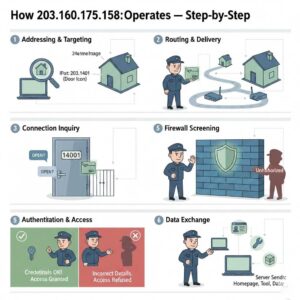
- The equipment you are using determines that 203.160.175.158 is the computer that it has to communicate with.
- It decides to check port 14001, which is as if it were checking a particular door in a house.
- It sends a message to that door to inquire whether it is open.
- If the server is a security guard, then it may require a login or credentials first.
- After checking the credentials, if they are accurate, access is granted.
- If the details are incorrect, the server will refuse the connection attempt.
- The server sends a homepage, a tool, or some sample data back to the user.
- Firewalls are like security guards for the request.
- Routers are like postal workers that deliver data to the correct location.
- Most of the time, people who are not allowed are also not able to locate this address — just like it is intended.
Real-World Parallels — Why This Makes Sense
The first time I thought of 203.160.175.158:14001 in terms of a corporate office building was pretty funny. The building address is 203.160.175.158. There are several rooms inside. Room 14001 can be a room IT server room or a data-processing lab.
You can come and see the building. You may even see its nameplate. However, unless you have clearance — a keycard, an ID, a pass — the door remains locked. Similarly, the digital address exists. But access needs permission.
Once this got through to me, those random IP-port combos didn’t scare me anymore. They became instruments. Locked instruments. Intended for certain people, doing certain jobs.
Why You Should Care About 203.160.175.158:14001
Knowledge about the connection 203.160.175.158:14001 is really helpful, even if you never intend to make that connection.
Firstly, it enables you to protect yourself. Just by randomly clicking on or by probing unknown IPs and ports can lead to dangerous situations. You may trigger security alerts. Also, your device may become vulnerable.
Secondly, it serves to build up your digital awareness. The internet is not only about the websites. It is a complicated network of gadgets, services, private servers — most of them concealed behind addresses like 203.160.175.158:14001. Knowing that puts you in a position to handle technology with more care.
The most important thing is that it helps you to keep your curiosity at bay when it comes to being cautious. There is nothing wrong with wondering what is behind. However, it is better to respect the limits.
Real Alternatives & Real Facts About 203.160.175.158:14001
There is a chance that you would never be in a position to relate 203.160.175.158:14001 to a publicly accessible domain or a friendly webpage. That is quite normal. Not every IP: port is meant to be shared.
Should you wish to follow a different path and learn, safer options are available: local servers (localhost), sandbox environments, or publicly documented open test servers. They expose you to ports and services — at the same time, they do not put you in the danger of intruding on someone’s private system.
When talking about real facts; probably, 203.160.175.158 is a location assigned by an ISP or a data-centre. Port 14001 is not associated with any standard public service. In unison, 203.160.175.158:14001 is like a private door. Not a billboard.

Lessons Behind the Scenes of 203.160.175.158:14001
This location from my perspective is silent but still it conveys several important lessons:
- The network is dependent on these unseen addresses and the services which are hidden.
- An address alone is not sufficient for getting access.
- Privacy as well as security depends more on hidden doors rather than open gates.
- However, the curiosity must be controlled by a sense of responsibility.
- Knowledge of networking on a basic level can be more rewarding than flashy apps.
Understanding 203.160.175.158:14001 allows me to see the beauty in the web’s silent architecture. I find a lot of charm in those layers that are hidden.
Red Flags to Watch For Around 203.160.175.158:14001
In case you come across 203.160.175.158:14001 in a message, a log, or a pop-up — you should handle that with care. Do not click immediately. not to input your credentials Or run unknown scripts.
Withdraw the address if it is trying to connect to you. If you didn’t expect it, it may be a harmful one. If a website announces “free access” to 203.160.175.158:14001, then be cautious and think of a possible scam.
On the whole, IP-port combinations that are unknown to you are less likely to be innocent. It is a more sensible decision to be on the lookout and keep away rather than be sorry and suffer later.

Wrapping Up 203.160.175.158:14001
When you think about it, 203.160.175.158:14001 is not that amazing. It is not a secret in a spectacular way. It’s merely a private address — a part of the internet that’s inaccessible to the general public. Knowing it has the effect of calming down the nerves. The unknown it removes. It demonstrates to you the very thing that electronic systems use to recognize, distinguish, and safeguard themselves. If you ever come across 203.160.175.158:14001 again — in logs, configs, or obscure references — you’ll understand its real nature. And you’ll know when it’s time to shut the door.
FAQs About 203.160.175.158:14001
1.What is 203.160.175.158:14001?
A: This is an IP address combined with a port number that uniquely identifies a certain service on a server.
2. Is 203.160.175.158:14001 a publicly accessible website?
A: No. It is most probably a service for private or internal use only, without being accessible to the general public.
3. Am I allowed to connect to 203.160.175.158:14001 without any worry?
A: Permission must be granted to you explicitly for that to be the case. Keep away from it if you don’t have permission.
4. Why 203.160.175.158:14001 behaving so weird?
A: The reason is that it is not operating like a regular domain. It does not have a name, a certificate, or a publicly accessible homepage.
5. What is my action when 203.160.175.158:14001 is found in a log or message?
A: Consider it as an address of the local network. Refrain from trying to log in. If necessary, inform the admin or security team that is responsible for your area.
Share this content:







Post Comment