







185.63.263.20 Explained: Real Meaning, Risks, and Why It Keeps Appearing
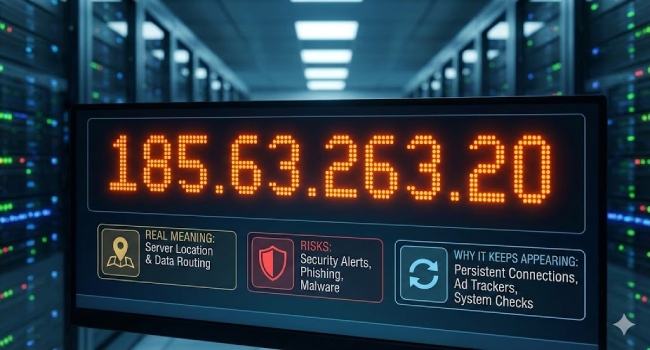
At the very first look, 185.63.263.20 seems like just another one of those random IPs. A number sequence that is easy to forget. A number that is quite easy to overlook. But if you frequently find 185.63.263.20 in your logs, alerts, or searches, then you cannot help but wonder what it really is. And maybe you are a little worried as well.
I see this phenomenon where it is very puzzling how something so technical can be suddenly felt as personal. The thing is when an IP address like 185.63.263.20 is being talked about, it is most probably related to security, risk, or confusion, in that area. How about we take it step wise, and in simple terms, to help you understand it better?
A Simple, Conversational Take on 185.63.263.20
An IP address can be compared to a house address for devices existing on the net. Any website, server or device which is internet enabled must have one. This is how data finds its way to the correct destination.
That’s when Ip starts to get a little bit weird. At first glance, it looks like a normal IPv4 address. There are four numbers with dots in between. It looks perfectly valid. But when you actually go in for a closer look, you will find an issue. The third number is 263. And that cannot be right.
IPv4 digits can only range from 0 to 255.
Therefore in fact, 185.63.263.20 is not a legitimate IPv4 address. Just that little bit of information confuses the people who are trying to figure it out.
What is 185.63.263.20
What 185.63.263.20 is all about in reality is there is no such address as 185.63.263.20 which is capable of being used on a publicly accessible internet. Servers cannot send data there. There is no way that a tool can pinpoint it with accuracy.
What I Have seen in my time looking through logs and security talks is that addresses similar to 1856326320 can usually be attributed to:
- Mistakes in writing down the address
- Incorrectly configured software
- Hidden or encrypted data
- Strings of bots created by automation
Why 185.63.263.20 Appearing/ Why People Search It
People researching the IP 185.63.263.20 are looking for four things with varying practicalities.
In the first place, it comes to be noticed in security alert. It is an act of firewall and intrusion detection system flagging it. Prompting reaction.
Secondly, it is found in the server logs. Admins see 18563.263.20 and want answers.
Third, curiosity of people. If something looks very technical and at the same time suspicious, then people look it up on Google.
In my observation, at times when users feel that they are being attacked, they make a lot of searches for 185.63.263.20. The truth is that most of these times, they are not actually being attacked.
Breaking Down 185.63.263.20 Step by Step
Is 185.63.263.20 a Valid IP?
Not at all. 185.63.263.20 does not adhere to the IPv4 standard.
Can 185.63.263.20 Locate a Device?
Negative. There isn’t any device that corresponds to 185.63.263.2
Can 185.63.263.20 Send Traffic?
If at all, it is not lawful. Any mention of 185.63.26320 may be an instance of data that is not properly formatted.
Why Does It Appear So Often?
It is because automated systems that are responsible for checking the validity of numbers in a given range do not always perform their duty perfectly.
You can compare it to a phone number that has one or two digits more than it should be. Even though it is written and shared, it still never receives a call.
Real-World Comparison That Makes Sense
Try to think of the scenario where you send a mail to a house with the number 9999 on a street that has the numbers only up to 500. Address 185.63.26would be something like that.
It is there in the world, at least on paper. But not really.
The Reason Behind Your Concern for 185.63.263.20
The reason why 185.63.263.20 should be of concern to you is that it conveys a very important message.
Not all the time that a “suspicious” label is attached to a thing, it is harmful. Sometimes it is just invalid.
Knowing this can save one a lot of time. It lessens the panic feeling. makes one able to trust his/her tools without having to overreact.
It is my experience that some people decide to block whole ranges due to 185.63.26320, while no threat is present.
Real Alternatives / Real Facts
The truth of the matter concerning 1856326320 is:
- IPv4 addresses cannot have numbers larger than 255
- There can still be invalid IPs in the logs
- Security tools identify patterns, not perpetrators
- 185.63.263.20 on its own cannot be the source of malware
Instead of being obsessed and worried about just 1856326320, why not checking for the valid neighboring IPs?
Lessons Behind 185.63.263.20
The number one lesson that one can get from 185.63.263.20 is becoming more aware.
Understand the way devices communicate on the net, learn the standards, and be skeptical of the notifications you receive.
According to my experience, professionals who know their fundamentals fare better in potions than those who panic.
More often than not, the presence of 185.63.263.20 is a call for getting educated not a sign for danger.
Red Flags to Watch For
Just because 185.63.26320 is invalid doesn’t mean you shouldn’t be looking for:
- Repeated login attempts
- Valid IPs with unusual behaviour
- High request volumes
- Unfamiliar geographic patterns
Wrapping Up
The bottom line with 185.63.263.20 is here.
The truth is, it is neither a real IP address nor a scary situation. 185.63.263.20 is just a technical-sounding string that is out of the question.
Most of the time, its being there, is a silent witness to the fact that we are looking at either logging errors, automation, or formatting issues. Not an active attack.
By learning about 185.63.263.200, you are honing your critical thinking skills when it comes to the presence of digital threats. And that interpersonal skill is very much needed.
FAQs
1. Is 185.63.263.20 harmful?
Definitely not. 185.63.263.20 is not a valid IP address, and thus, it can never be the direct source of a threat.
2. Why do we see 185.63.263.20 in security logs?
That might be due to systems sometimes logging malformed or automated data.
3. Could 185.63.263.20 be traced?
No. One cannot trace 185.63.263.20.
4. Should a person put a stop to 185.63.263.20?
There won’t really be any effect from the act of stopping 185.63.263.20 as it cannot be accessed via normal routing.
5. What are the next steps if incidents with 185.63.263.20 are common?
Check out your logging-gear and be looking for real IPs patterns instead of concentrating merely on 185.63.263.20.
Also Read:- 203.160.175.158:14001: Understanding This IP and Port Combination
Share this content:









Post Comment